


Ever noticed how a well-placed question can make you stop scrolling and pay attention to a product description? Have you wondered why some questions make you more likely to click “Add to Cart”? What if I told you there’s a science behind using questions to boost your sales? In this article, we’ll dive deep into the fascinating world of rhetorical questions in product descriptions and how they can transform your conversion rates. By the time you finish reading, you’ll understand the psychology behind question-based persuasion, know exactly which types of questions to use for different products, and have a complete framework for implementing this powerful technique in your own business. Ready to discover how a simple punctuation mark can dramatically increase your sales? Let’s begin!
Psychological Foundations of Rhetorical Persuasion
Before we start crafting compelling questions for your products, it’s important to understand why questions work so effectively on the human brain. This section will explore the fascinating cognitive, emotional, and behavioral mechanisms that make rhetorical questions such powerful tools in product descriptions.
Cognitive Engagement Mechanisms
When a customer reads a question in your product description, something remarkable happens in their brain. Questions activate the prefrontal cortex – the part of your brain responsible for complex thinking and self-reflection. Unlike statements that customers can easily ignore, questions demand mental participation.
For example, when you ask “Tired of spending hours cleaning your kitchen?” your potential customer can’t help but mentally answer the question. This active participation creates a stronger memory imprint and reduces skepticism, as the customer has now engaged with your message on a deeper level than if you had simply stated “Our product saves cleaning time.”
Emotional Triggers
Questions don’t just engage the logical brain – they tap into powerful emotions too. When you pose an intriguing question that hints at a solution without revealing everything, you create what psychologists call a “curiosity gap.” This gap triggers dopamine release – the brain’s reward chemical – making customers feel good as they continue reading to satisfy their curiosity.
Additionally, questions that acknowledge common problems can reduce anxiety by implying that: 1) the customer isn’t alone in their struggle, and 2) a solution exists. For instance, “Frustrated by hair products that promise but don’t deliver?” establishes shared experience, reducing the customer’s anxiety about trying yet another product that might disappoint.
Behavioral Economics Framework
From a behavioral economics perspective, rhetorical questions simplify the decision-making process by guiding customer focus. When you ask “Why pay more for less coverage?” you’re framing the choice architecture in favor of your better-value product.
Questions can also leverage principles like loss aversion by highlighting what customers might miss out on. “What would you do with an extra hour each day?” helps customers visualize the opportunity cost of not buying your time-saving product.
Now that we understand why questions work so powerfully on the human mind, aren’t you curious about which specific types of questions will work best for your products? Let’s explore the most effective question formats that top-performing businesses use to drive conversions!
Types of Rhetorical Questions in Commerce
Not all questions are created equal when it comes to selling products. In this section, we’ll break down the three most effective types of rhetorical questions that can transform your product descriptions from boring to brilliant – and more importantly, from overlooked to purchased!
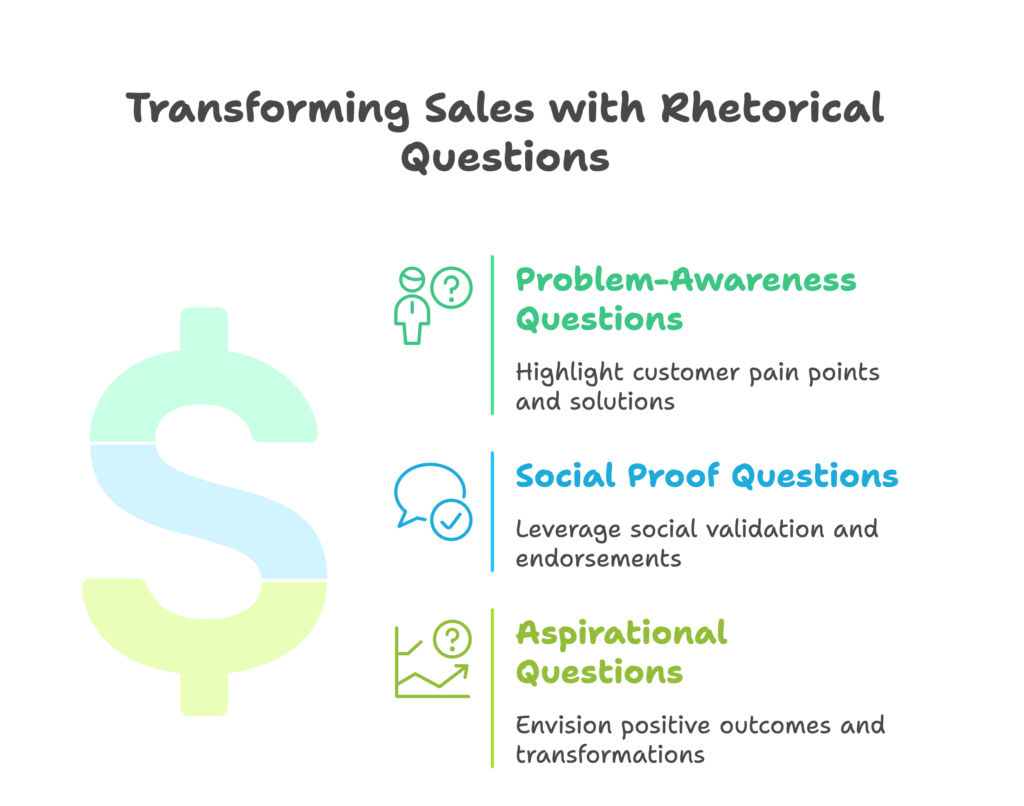
Problem-Awareness Questions
These questions highlight a pain point or challenge that your product solves. By bringing awareness to a problem, you create an immediate connection with customers experiencing that issue.
Examples include:
- “Tired of products that break after just a few uses?” (Highlighting durability)
- “Struggling to find clothes that actually fit?” (Addressing sizing frustrations)
- “Why settle for dull, lifeless skin when you could glow?” (Creating contrast between current state and desired outcome)
Problem-awareness questions work because they validate the customer’s experiences and position your product as the solution they’ve been searching for.
Social Proof Questions
These questions leverage the power of social validation by implying that many others have already made the choice to purchase – and are happy with their decision.
Effective examples include:
- “What would 10,000 satisfied customers recommend for removing tough stains?” (Implying mass adoption)
- “Want to know which hair tool professional stylists use most?” (Highlighting expert endorsement)
- “Curious why this became our bestselling item three years running?” (Creating intrigue around popularity)
Social proof questions tap into our innate desire to make choices that align with group wisdom, reducing perceived purchase risk.
Aspirational Questions
These questions help customers envision a better future state that your product can help create. They focus on desires, dreams, and positive outcomes rather than problems.
Powerful examples include:
- “Ready to transform your morning routine forever?” (Promoting positive change)
- “What if one change could double your productivity?” (Promising significant improvement)
- “How would it feel to start each day with boundless energy?” (Encouraging emotional visualization)
Aspirational questions are particularly effective for lifestyle products, luxury items, and anything that promises transformation or enhancement.
Now that you have a toolkit of question types at your disposal, you might be wondering where and how to strategically place them for maximum impact. What’s the point of crafting the perfect question if it’s positioned where no one will see it? Let’s find out how to implement these powerful questions throughout your customer journey!
Strategic Implementation Framework
Knowing which questions to ask is only half the battle. Where, when, and how you position these questions can dramatically impact their effectiveness. This section provides a practical framework for strategically implementing rhetorical questions throughout your product pages and marketing materials.
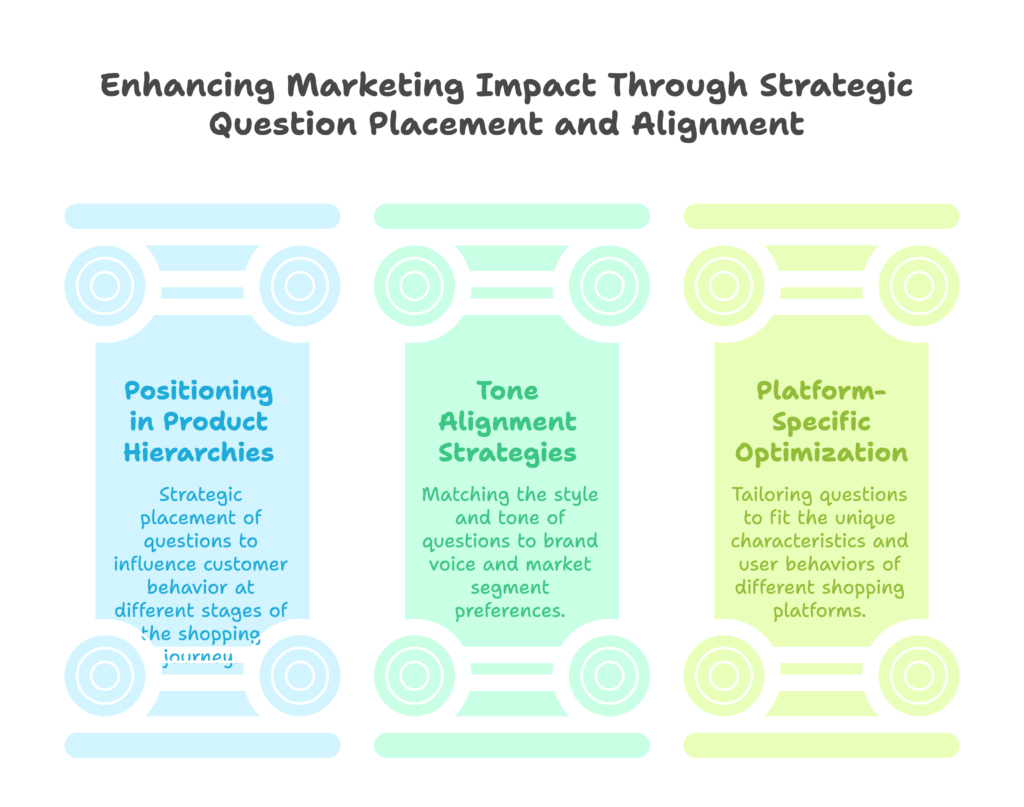
Positioning in Product Hierarchies
The placement of questions within your product page creates different psychological effects. Consider these strategic positions:
- Above-fold questions should focus on grabbing attention and establishing relevance. Example: “Looking for a solution that actually works?” This immediately engages visitors who might otherwise bounce.
- Mid-page questions work best when guiding customers through features and benefits. Example: “Why do professional photographers choose our lenses?” This helps maintain interest as customers scroll.
- Checkout-adjacent questions should create urgency or reinforce the wise purchase decision. Example: “How soon would you like to start enjoying these benefits?” This helps overcome last-minute hesitation.
Tone Alignment Strategies
Your questions must match your brand voice and product positioning. Different market segments respond to different question styles:
- Luxury brands benefit from questions that emphasize exclusivity and craftsmanship. Example: “Shouldn’t your accessories reflect the success you’ve earned?”
- Eco-conscious brands should focus on legacy and impact. Example: “What kind of planet do you want to leave for future generations?”
- Tech products perform best with questions highlighting efficiency and innovation. Example: “How much time could you reclaim with smarter automation?”
Platform-Specific Optimization
Different shopping environments require tailored approaches:
- Mobile shoppers respond best to concise questions (under 7 words) due to smaller screens and typically faster browsing pace.
- AR/VR experiences benefit from immersive, experiential questions like “Can you imagine how this would look in your space?”
- Voice commerce requires questions with natural speech patterns that consider how questions sound when read aloud.
Now that you know where to place your questions and how to align them with your brand and platform, aren’t you curious about how to fine-tune them for maximum conversion impact? Let’s dive into the science of crafting questions that not only engage but actually drive purchasing decisions!
Conversion-Focused Question Design
Creating questions that convert isn’t just an art—it’s a science backed by research on cognitive processing, cultural considerations, and ethical standards. This section will help you design questions that are optimized for driving conversions while respecting your customers.
Cognitive Load Management
The human brain has limited processing capacity, especially when making purchase decisions. To maximize the impact of your questions:
- Keep questions between 5-7 words for optimal processing. “Ready for smoother skin tonight?” performs better than “Have you been wondering if there might be a better solution for your persistent skincare concerns?”
- Focus on one idea per question. “Tired of high energy bills?” works better than “Tired of high energy bills and looking for an eco-friendly solution that saves money while helping the planet?”
- Use progressive disclosure by sequencing questions from simple to more complex as customers move deeper into your content.
Cultural Adaptation Matrix
Question effectiveness varies significantly across cultures. Consider these adaptations:
- Some cultures respond better to direct questioning while others prefer indirect approaches. For global markets, test both “Why wait any longer?” (direct) versus “What might happen if you waited?” (indirect).
- Numerical preferences vary by region. “Why do 9 out of 10 chefs choose our knives?” might work in some markets, while “Why do thousands of professionals trust our tools?” might work better in others.
- Be aware of taboo topics that vary regionally when crafting questions about personal products, financial matters, or health concerns.
Ethical Implementation Guardrails
Effective questioning doesn’t mean manipulative questioning. Maintain ethical standards by:
- Ensuring truth-in-questioning by only implying claims you can substantiate. “Why do dermatologists recommend our formula?” requires actual dermatologist endorsements.
- Including vulnerability protections by avoiding questions that exploit emotional weaknesses or insecurities, especially for health, beauty, or financial products.
- Reviewing for dark patterns by checking if your questions create false urgency or misleading impressions.
You’ve now learned how to craft questions that are cognitively optimized, culturally sensitive, and ethically sound. But how will you know if they’re actually working? The next section reveals exactly how to measure and optimize your questioning strategy for continuous improvement!
Measurement & Optimization
Even the most carefully crafted questions need measurement and refinement to reach their full potential. This section will show you how to track the impact of your rhetorical questions and continuously improve their performance.
Engagement Metrics
To understand how your questions affect user behavior, monitor these key metrics:
- Dwell time on sections containing questions compared to sections without questions. Effective questions typically increase time spent by 15-40%.
- Scroll depth correlation to see if questions encourage deeper page exploration. Look for patterns like increased scroll depth following strategically placed mid-page questions.
- Heatmap analysis to visualize where users pause and engage. Effective questions create distinctive “hot spots” of engagement on your page.
Conversion Impact Tracking
To directly link questions to sales, implement these measurement strategies:
- Conduct A/B tests with different question placements, styles, and types. For example, test “Ready to transform your skin?” against “Isn’t it time to transform your skin?” to see which drives more conversions.
- Track micro-conversions like add-to-cart rates or email sign-ups that occur immediately after question exposure.
- Analyze return rates against question types to ensure your questions aren’t creating unrealistic expectations that lead to disappointed customers.
Sentiment Analysis
To understand the emotional impact of your questions:
- Use NLP (Natural Language Processing) tools to categorize emotional responses in reviews and customer feedback.
- Implement post-purchase surveys that measure question recall and influence on purchase decisions.
- Monitor social media sentiment when customers share your product pages or quote your questions.
Now that you understand how to measure the impact of your rhetorical questions, wouldn’t you like to see real-world examples of brands that have mastered this technique? Let’s explore some fascinating case studies that demonstrate the remarkable power of strategic questioning!
Case Studies in Strategic Questioning
Theory is valuable, but nothing demonstrates the power of rhetorical questions quite like seeing them in action. This section highlights three companies that have masterfully employed questioning strategies to achieve impressive results.
Dyson’s Vacuum Descriptions
Dyson revolutionized its product descriptions by focusing on problem-awareness questions:
- Their signature question “Why settle for weak suction?” directly challenges competitors while highlighting Dyson’s key advantage.
- This simple question contributed to a remarkable 23% conversion lift when added to product pages.
- Post-purchase surveys revealed an impressive 68% recall rate of this specific question, demonstrating its memorable impact.
Dyson’s approach works because it addresses a universal frustration (poor vacuum performance) while implying that accepting this problem is a choice rather than a necessity.
Glossier’s Skincare Line
Glossier built a cult following partly through aspirational questioning:
- Their campaign centered around the question “What if your makeup loved you back?” created an emotional connection with customers tired of products that damaged their skin.
- This question framework helped drive a 41% increase in user-generated content as customers responded to the question with their own experiences.
- The question’s success came from reframing the relationship between consumer and product from transactional to reciprocal.
Patagonia’s Ethical Positioning
Patagonia uses questions to reinforce its commitment to ethical manufacturing:
- Their “Who makes your gear?” campaign turned supply chain transparency from a potential liability into a selling point.
- This questioning approach contributed to a 57% increase in loyalty program sign-ups as consumers aligned themselves with the brand’s values.
- The question works by prompting competitors’ customers to realize they don’t know the answer for their current gear, creating cognitive dissonance that Patagonia resolves.
These case studies demonstrate how different industries can leverage different questioning approaches to achieve specific marketing objectives. But as we implement these powerful techniques, shouldn’t we also consider the ethical implications? Let’s explore how to use rhetorical questions responsibly in the next section.
Ethical Considerations
With great persuasive power comes great responsibility. This section explores how to balance effective persuasion with ethical considerations to build sustainable customer relationships based on trust.
Truthfulness Boundaries
Ethical questioning requires strict adherence to truth:
- Only use verified scarcity claims in questions like “Why miss out on our limited edition?” when products are genuinely limited.
- Ensure evidence-backed performance questions such as “Looking for a cream proven to reduce wrinkles by 40%?” are supported by legitimate testing.
- Avoid cultural appropriation in your questioning strategies, especially when marketing globally or to diverse audiences.
Cognitive Protection Measures
Responsible marketers protect vulnerable customers:
- Implement addiction pattern monitoring for products like gaming or subscription services to avoid exploiting compulsive behaviors.
- Include financial pressure safeguards by avoiding questions that shame customers into purchases beyond their means.
- Develop age-specific guidelines for questions targeting products that may be used by minors or the elderly.
Transparency Standards
Building trust requires transparency:
- Consider question intent disclosure in sensitive categories by clearly stating your marketing objectives.
- Respect data collection consent by avoiding questions that deceptively gather personal information.
- If using AI-generated questions, regularly audit them for bias, accuracy, and ethical alignment.
Now that we understand how to use rhetorical questions ethically, what might the future hold for this powerful persuasion technique? The landscape of e-commerce is constantly evolving – let’s explore what’s on the horizon for conversational commerce and questioning strategies!
Future of Conversational Commerce
The way we use questions in product descriptions is evolving rapidly with technological advances. This section explores emerging trends that will shape how we engage customers through questioning in the coming years.
Emerging Technologies
Several innovations are transforming question-based marketing:
- AI-generated personalized questions that adapt based on customer browsing history, demographics, and past purchases will create uniquely resonant experiences.
- Biometric response tracking through devices like smartwatches or eye-tracking technology will help refine questions based on actual physical and emotional responses.
- Blockchain verification for claims implied in questions will build trust by allowing customers to independently verify product origin, testing results, or scarcity claims.
Predictive Systems
Advanced analytics will revolutionize questioning strategies:
- Lifetime value modeling will help tailor questions that not only drive initial conversion but optimize for long-term customer relationships.
- Cultural shift prediction will help brands anticipate changing sensitivities and preferences before they become mainstream.
- Real-time A/B testing will allow questions to be refined during a single shopping session based on immediate customer response.
Theoretical Developments
Academic research is expanding our understanding of persuasive questioning:
- Quantum persuasion models that consider the probabilistic nature of consumer decision-making may replace more linear persuasion frameworks.
- Cross-modal questioning research examines how questions presented across different senses (visual, audio, haptic) might compound persuasive impact.
- Neuroethical frameworks are developing to help marketers balance effectiveness with responsibility as our understanding of the brain’s decision processes deepens.
As we’ve seen throughout this article, rhetorical questions are powerful tools for engaging customers, addressing pain points, leveraging social proof, and inspiring action. By understanding the psychology behind questions, selecting the right types, implementing them strategically, and measuring their impact, you can significantly boost your product descriptions’ effectiveness while maintaining ethical standards.
Remember: Shopify store owners can take their questioning strategies to the next level with the Growth Suite application, which offers AI-powered question generation, A/B testing capabilities, and conversion analytics to help you optimize your product descriptions for maximum sales. Why leave money on the table when an effective question strategy could transform your conversion rates?
References
- Study.com. (2023). Rhetorical Question Effects. https://study.com/academy/lesson/rhetorical-question-in-literature-definition-effect-examples.html
- Printwand. (2018). Advertising Questions. https://www.printwand.com/blog/should-you-use-rhetorical-questions-in-advertising
- CopywriterBrain. (2021). Persuasive Techniques. https://copywriterbrain.com/six-persuasive-copywriting-techniques
- LinkedIn. (2024). Web Content Questions. https://www.linkedin.com/advice/1/how-can-you-use-rhetorical-questions-improve-your-jgwef
- Cantaloupe Marketing. (2024). Question Strategies. https://www.cantaloupemarketing.co.uk/blog/how-and-why-to-use-questions-in-your-copy
- LinkedIn. (2024). Business Content Marketing. https://www.linkedin.com/pulse/power-rhetorical-questions-business-content-marketing-wrclf
- Shopify. (2025). Product Description Guide. https://www.shopify.com/blog/8211159-9-simple-ways-to-write-product-descriptions-that-sell
- Creative Copywriter. (2024). Question Implementation. https://www.creative-copywriter.net/business-copywriting/how-to-use-questions-in-your-copy-without-sounding-annoying