

Have you ever noticed how some people who know very little about a subject are so sure of themselves, while those who truly are experts tend to underestimate their abilities? This intriguing puzzle lies at the heart of the Dunning-Kruger effect, and it has a real impact on everyday customer support interactions. By reading this article, you’ll discover why it happens, how it affects your support team and your customers, and what you can do to address it. Ready to explore? Let’s dive in!
In this section, we’ll introduce the Dunning-Kruger effect in the context of customer service. You’ll learn about its history, how it can appear in professional service situations, and why it matters economically for support teams. By the end of this part, you’ll see how crucial it is to understand this bias for better customer experiences. Stay tuned for more as we move forward.
Defining the Dunning-Kruger Effect in Service Environments
The Dunning-Kruger effect was first described by social psychologists David Dunning and Justin Kruger. It explains how people with limited knowledge often overestimate their abilities, while those with more knowledge can underestimate theirs. In service environments, this can mean inexperienced support agents feeling overly confident, or skilled experts second-guessing themselves.
Historically, the concept emerged from observations that unskilled individuals might not only perform tasks poorly but also fail to realize they are doing so. In customer service, this “dual burden” can show up in many ways, from agents thinking they’ve solved a problem too quickly to experts doubting their well-earned competence. Economic impacts arise when these biases cause longer call times, lower customer satisfaction, or lost revenue.
We’ve laid the groundwork for what the Dunning-Kruger effect is. But understanding it fully also means seeing the broader landscape of customer support. Let’s head there next!
The Customer Support Landscape
Customer support has evolved from basic help desks to multi-channel and digital-first environments. Emails, live chats, social media, and even video calls are now common ways to connect with customers. This shift has made support interactions more complex, especially as customer expectations keep rising.
In today’s digital era, customers may arrive with advanced questions or partial information. The knowledge gap between what they think they know and what they truly know can lead to communication breakdowns. Yet support remains a critical moment in the entire customer journey, shaping how people feel about a brand or product.
Now that we’ve outlined the changing support environment, you’re probably wondering how biases fit into this puzzle. Let’s check out the meeting point of cognitive biases and service excellence next!
The Intersection of Cognitive Biases and Service Excellence
Cognitive biases can be especially potent in customer support. Why? Because both agents and customers are under stress, and decisions often happen quickly. The Dunning-Kruger effect surfaces when agents misjudge their abilities, or customers misjudge their own technical understanding. This can lower satisfaction, harm customer retention, and eat into profits.
Addressing these biases is good for business. Providing the right training and awareness helps ensure customers walk away feeling supported, leading to better long-term loyalty. In short, dealing with the Dunning-Kruger effect head-on makes practical sense for any support team looking to deliver top-notch service.
Next, we’ll dive into the direct ways the Dunning-Kruger effect appears in real support interactions. Ready to see where you might recognize these scenarios? Let’s move on!
Manifestations of the Dunning-Kruger Effect in Customer Support
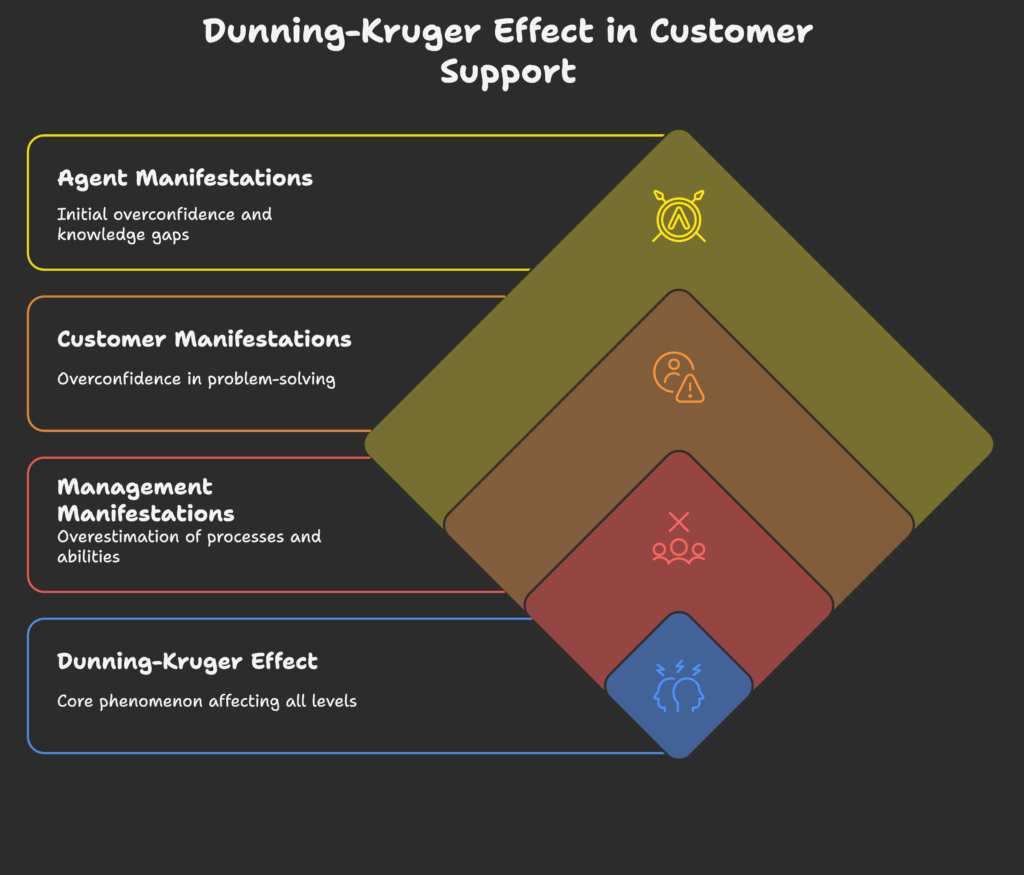
In this section, we’ll look at how the Dunning-Kruger effect shows up in the actions of support agents, customers, and even management. You’ll discover common behaviors that signal someone might be overestimating or underestimating their abilities. By the end, you’ll have a clearer picture of these pitfalls, so you can identify and address them in your own organization. Let’s get started!
Agent-Side Manifestations
Agents new to the job may feel overconfident simply because they are unaware of how much there is to learn. They might believe they’ve “got it all figured out” after basic training, missing important gaps in their knowledge. This can stop them from asking for help or escalating complex cases. Over time, more experienced agents often develop a more realistic sense of what they do and do not know, but a mismatch can still occur if the environment is constantly changing.
When agents resist acknowledging limits, they may give incorrect answers or refuse to escalate to higher tiers of support. This can hurt both the customer experience and the agent’s ability to learn effectively.
We’ve covered how agents can fall into this trap. But customers can also show Dunning-Kruger traits. Let’s check that out next!
Customer-Side Manifestations
Some customers come in believing they’ve tried everything, even if they’ve only tested a few options. They might overestimate their technical knowledge, so they insist they’ve ruled out all possibilities. This can create tension when the agent asks them to follow basic troubleshooting steps they thought they had already completed.
Customers can also set unrealistic expectations, assuming a solution is simple when it actually requires multiple steps or specialized knowledge. Prior experiences might make them confident, yet incomplete, in their approach.
Customers aren’t alone in this phenomenon—managers can be vulnerable too! Let’s explore how the Dunning-Kruger effect appears in leadership decisions next.
Management-Side Manifestations
Managers may overestimate how effective their support processes or chosen technologies really are. They might assume that a particular tool can handle any problem, only to discover too late that it falls short in more advanced scenarios. In other cases, they might assume agents have mastered certain tasks without verifying real performance metrics.
Studies even show that a significant number of managers tend to overrate their own abilities, which can lead to unrealistic goals or blind spots in decision-making. These issues can filter down and impact the entire support team, from daily workflows to long-term strategies.
Now that we know where Dunning-Kruger can appear, let’s see why these behaviors take root. We’ll head into the psychological underpinnings next!
Psychological Foundations of the Dunning-Kruger Effect in Support Interactions
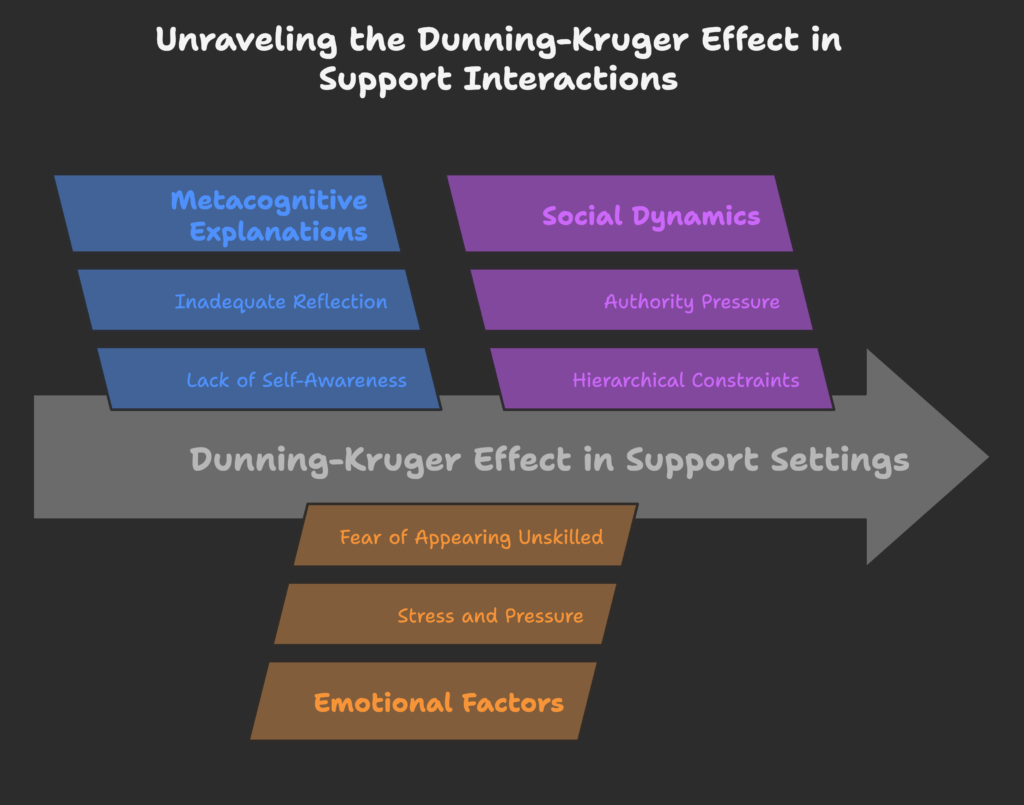
This section explains the deeper reasons behind the Dunning-Kruger effect. By understanding these roots, you’ll gain insights into how best to prevent and fix issues caused by this bias in your support environment. We’ll examine metacognitive factors, emotional pressures, and social dynamics. Let’s discover what makes this bias so persistent.
Metacognitive Explanations
Metacognition is our ability to think about our own thinking. In support contexts, when we lack knowledge, we are also less able to see that knowledge gap. This “dual burden” is a classic hallmark of the Dunning-Kruger effect. Agents working with highly technical products or constantly updated software may not realize just how much there is to learn.
Over time, as agents gain experience and practice self-reflection, they develop better metacognition. This helps them spot their own limits and ask for guidance when needed.
We’ve touched on the thinking aspect. But emotions also play a critical role. Let’s take a look at that next!
Emotional Factors in Support Interactions
Customer service can be stressful for both agents and customers. Under pressure, people often want quick closures to problems. Agents or customers might latch onto a simple explanation to avoid discomfort, resulting in premature or incorrect solutions.
Sometimes, fear of appearing unskilled can make someone push back on advice. They might prefer to maintain the illusion of competence rather than risk seeming unprepared. These emotions act as barriers to genuine learning and problem-solving.
So far, we’ve seen how knowledge and emotions shape Dunning-Kruger. Next, we’ll see how social factors—like status and hierarchy—can also play a role. Keep reading!
Social Dynamics and Power Relationships
Customer support often involves different levels of authority: agents, customers, managers, and sometimes external specialists. Agents may feel pressured to demonstrate expertise, while customers might assert their own “expert” status by downplaying the agent’s instructions. Meanwhile, organizational hierarchy can discourage honest communication if team members feel they must always appear knowledgeable.
These social pressures can intensify the Dunning-Kruger effect, making individuals cling to incorrect beliefs to save face. This disrupts true collaboration and might hide problems until they become critical.
Now that we understand the psychology behind it, let’s see how this bias impacts real business metrics and customer experiences. Stick around!
Impact Analysis: The Business Consequences
This section reveals what happens to performance, customer satisfaction, and company culture when the Dunning-Kruger effect goes unchecked. You’ll see how it influences key metrics and team dynamics, emphasizing why it’s so crucial to address. Let’s explore these consequences in detail.
Performance and Efficiency Metrics
Overconfident support agents can cause longer call times because they may not escalate issues promptly. This lowers the first contact resolution rate. Complex tickets can get reopened more often if the initial solution was incomplete. When leadership is aware of these patterns, they can target training or system changes to improve results.
Research suggests teams led by self-aware leaders can outperform others by significant margins—sometimes up to 50%. This points to a direct link between knowing what you don’t know and achieving better performance.
Performance is one thing, but customer experience is another key aspect. Let’s explore that next!
Customer Experience Impact
Customer satisfaction is closely tied to how confident and capable agents appear. Overconfident but misinformed agents can disappoint customers, leading to lower Net Promoter Scores (NPS). When agents and customers collaborate realistically, trust grows, and the company earns a reputation for reliable support.
If a support issue fails to be resolved due to incorrect assumptions, it can leave a lasting negative impression. This can push customers away, harming not only future sales but also word-of-mouth referrals.
Team culture is the final piece of this puzzle. Let’s see how the Dunning-Kruger effect shapes collaboration and growth.
Organizational Culture and Team Dynamics
An environment with frequent overconfidence may discourage knowledge sharing. Why ask for help if everyone believes they know enough already? This can block continuous learning and stifle innovation.
When people admit they don’t know something, it creates chances for genuine improvement and creative problem-solving. Teams that embrace humility and curiosity can adapt and thrive, while those trapped by Dunning-Kruger run the risk of stagnation.
At this point, you might wonder, “How do we spot these issues in day-to-day operations?” That’s exactly what we’ll cover next!
Identifying the Dunning-Kruger Effect in Support Scenarios
Here, you’ll learn practical ways to detect warning signs of Dunning-Kruger in agent behaviors, customer communications, and technical systems. By recognizing these signals, you can act quickly to prevent missteps and guide your team toward better outcomes. Let’s uncover these diagnostic tools together.
Diagnostic Indicators in Agent Behavior
Overly confident language can signal a blind spot. For example, phrases like “I’m absolutely certain…” on complex issues might warrant a closer look. Agents who rarely seek feedback or show resistance to new training may not recognize their own limits.
Measuring self-assessment accuracy over time can also reveal patterns. If an agent consistently believes they excel in areas where they underperform, it’s a clue they might be stuck in the Dunning-Kruger cycle.
Of course, customers have their own telltale signs. Let’s explore them next!
Identifying the Effect in Customer Communications
When customers misuse technical terms or contradict themselves, they might be overestimating their knowledge. They may also dismiss simple troubleshooting steps as unnecessary, believing they’ve already tried everything. This can make conversations longer and more difficult.
Repeated escalations that reveal a much simpler fix than the customer imagined are another sign. It’s important for agents to approach these situations with patience and clear guidance, reducing frustration on both sides.
Beyond people, we also need to evaluate the tools and systems in place. Let’s discuss that next!
Technology and Systems Assessment
Sometimes, overconfidence lies in assumptions about what a platform or software can do. If your knowledge management system is too complex or lacking important articles, it can fool agents into thinking the answers are more accessible than they really are.
Automation tools are helpful, but if the team believes they solve everything without proper checks, that’s the Dunning-Kruger effect at work. Objective metrics—like actual resolution rates—must be balanced with subjective feedback to get a true picture of how well your tools perform.
Now that you know how to spot trouble, it’s time to learn how to fix it. Ready to see those solutions? Let’s move on!
Intervention Strategies for Support Organizations
In this section, we’ll look at practical steps you can take to minimize the impact of Dunning-Kruger within your support team. We’ll cover agent training, customer education, and management development. By the end, you’ll have a toolkit for turning insight into action.
Agent Training and Development
Encouraging self-reflection and metacognitive skills is vital. Agents benefit from training sessions that reveal blind spots and promote realistic self-assessment. Techniques like peer reviews let them see how others solve the same issues, providing more than one perspective.
Providing a safe space to admit uncertainty is also key. When agents can say, “I’m not sure,” and get support, they learn faster and serve customers better.
But agents aren’t the only ones who need guidance. Let’s see how to support customers in bridging their own knowledge gaps next.
Customer Education and Expectation Management
Use clear, step-by-step guides and help center articles that do not assume high-level technical skills. Short videos and guided troubleshooting flows can help customers understand the actual complexity of their issue.
You can also provide prompts like “Did you know?” or “Let’s double-check…” during support interactions. This manages expectations and helps customers see what they might have missed.
Now, let’s talk about leadership—because management teams hold a lot of power to shape company culture.
Management and Leadership Development
Managers should rely on objective data when evaluating support tools, agent performance, and new initiatives. This means checking real metrics rather than assumptions. Creating feedback loops where frontline agents can share insights helps leaders avoid overestimating solutions.
Leaders can also encourage cross-functional learning. By understanding a bit of what different departments do, they reduce the risk of making big decisions based on incomplete knowledge.
We’ve looked at strategies for people and culture. Next, we’ll dig into communication methods that help overcome Dunning-Kruger. Keep reading!
Communication Strategies to Overcome the Dunning-Kruger Effect
Good communication is a powerful tool against the Dunning-Kruger effect. In this section, we’ll cover agent techniques, knowledge sharing, and feedback methods. These strategies can smooth out tricky conversations and promote a culture where learning is valued.
Agent Communication Techniques
Agents can use a friendly, open-ended style to uncover the customer’s real level of understanding. For instance, asking “Could you walk me through what you’ve tried so far?” reveals hidden assumptions.
When customers are overconfident, agents can gently guide them with facts and careful explanations, maintaining respect and rapport. Even simple language choices can reduce defensiveness, making it easier for the customer to accept correct information.
Communication goes beyond direct conversations. Let’s see how knowledge transfer plays a role.
Knowledge Transfer Optimization
Effective documentation with clear visuals or analogies helps both agents and customers grasp complex details. When technical instructions are broken down into small steps, it’s easier to confirm understanding.
Another helpful approach is using “scaffolded” content that gradually moves from basic to more advanced concepts. This structure supports varied levels of knowledge without making anyone feel lost or overwhelmed.
Finally, let’s look at how feedback loops and performance reviews can nurture an environment free from dangerous overconfidence.
Feedback and Performance Review Approaches
Teams benefit from performance metrics that highlight both success and areas for improvement. Honest, respectful feedback helps pinpoint when someone’s self-assessment doesn’t match reality.
Peer coaching is also effective. When team members review each other’s calls or chats, it offers a fresh perspective. Recognizing and rewarding growth in knowledge, not just speed or closure rates, encourages a healthier support culture.
Next, we’ll explore the technology tools that can further support these strategies. Keep going!
Technology and Tools for Mitigating the Dunning-Kruger Effect
Here, we’ll talk about platforms and systems that can help spot and reduce the impact of overconfidence in your support processes. By using well-designed knowledge management, quality assurance, and customer self-service tools, you can help everyone make more accurate judgments. Let’s see how.
Knowledge Management Systems
A strong knowledge management system can present information in tiers—from simple explanations to more advanced details. This layered approach helps both new and experienced agents find the depth they need.
Data analytics on article usage can also signal knowledge gaps. If agents frequently search for specific issues but rarely find the right article, it might be time to create more resources or refine existing ones.
Next up: How to keep an eye on conversations to catch overconfidence early.
Quality Assurance and Monitoring Tools
Modern contact centers often use conversation analytics to identify patterns—like an agent repeatedly expressing unwavering certainty on complex topics. Automated systems can flag these calls for review and coaching.
Dashboards that show handle times, resolution rates, and escalations help managers see where Dunning-Kruger might be creeping in. By combining these metrics, leaders get a more complete picture of their team’s performance.
Of course, many customers prefer self-service. Let’s see how to design that effectively to prevent confusion.
Customer Self-Service Design
Well-structured self-service portals guide users step by step, showing them what they might be missing before they reach out to a live agent. Simple language, visuals, and interactive elements can improve understanding.
By including quick feedback tools—like a “Was this helpful?” button—you gather immediate data on whether customers truly comprehend the material. These small touches can catch overconfidence early and prompt users to recheck steps they might have skipped.
Now let’s get practical with real-world examples of how companies have applied these ideas. Ready? Let’s go!
Case Studies and Practical Applications
In this section, we’ll explore examples of support organizations that overcame the Dunning-Kruger effect, industry-specific tweaks, and how approaches can vary between small teams and large enterprises. By the end, you’ll see that no matter your setup, there’s a way to tackle this bias.
Turnaround Scenarios in Support Organizations
Some companies started by noticing high ticket reopening rates and discovered overconfidence among new agents. By implementing metacognitive training, those rates went down, and customer satisfaction rose.
These organizations often find that shifting the culture—so it’s okay to not know everything—pays off in the long term. ROI can come from reduced handle times, fewer escalations, and happier customers.
But different industries face different challenges. Let’s see how the Dunning-Kruger effect plays out across various sectors.
Industry-Specific Applications
- Technical Support: Rapidly evolving software can make it easy to overestimate how much you understand about new features.
- Financial Services: Complex regulations can trick both customers and agents into thinking they have it all figured out when they don’t.
- Healthcare Support: Clinical terms and detailed patient advice require accuracy, so overconfidence can be risky.
- SaaS Products: Frequent updates lead to knowledge gaps, which can be hidden by overconfidence.
- Consumer Electronics: Technical intimidation can make customers more prone to believing they’ve tried all solutions.
Whether you’re a small startup or a large enterprise, the main principles remain the same. Let’s see how resources shape your approach next.
Small Team versus Enterprise Approaches
Smaller teams might rely on close-knit peer review and open chats for immediate feedback. They can move quickly to correct mistakes or fill knowledge gaps, thanks to simpler workflows.
Larger enterprises may need structured training programs, detailed analytics, and formal feedback loops to handle the sheer number of agents. Both approaches focus on honest self-assessment, knowledge sharing, and continuous improvement.
So what does the future hold for the Dunning-Kruger effect in support? Let’s take a glimpse!
Future Trends and Emerging Considerations
In this section, we’ll look ahead at how AI, remote support, and ongoing measurements will influence the fight against the Dunning-Kruger effect. You’ll see why staying adaptable and data-driven is key to thriving in a rapidly changing environment.
AI and Automation Implications
Artificial intelligence can help by suggesting solutions, detecting inconsistencies in agent or customer statements, and learning from new problems. However, if managers overestimate what AI can do without careful oversight, they fall right into the Dunning-Kruger trap. Human-AI teamwork works best when people remain aware of the technology’s limits.
This can make knowledge gaps more visible. For instance, if an AI assistant flags an issue an agent overlooked, it’s a cue for further training rather than a sign to ignore human input.
Remote work adds another layer. Let’s examine that next.
Remote and Distributed Support Challenges
Virtual teams might find it harder to share informal knowledge without quick in-person chats. Video-based support can help bridge the gap, but cultural differences or language barriers can increase confusion.
Clear documentation and consistent communication tools become even more important in remote settings. This ensures everyone—agents and customers alike—has the information they need, reducing the chance of inflated confidence.
Finally, let’s see how to measure your progress over the long term.
Measuring Success and Continuous Improvement
To stay effective, track both immediate metrics (like call resolution times) and long-term ones (like customer lifetime value). Look for patterns that suggest agents or customers may be missing key knowledge.
Building a culture of continuous learning, where everyone is encouraged to update skills and share insights, helps organizations adapt. This kind of environment keeps the Dunning-Kruger effect at bay by making sure everyone knows there’s always more to learn.
Now, let’s wrap it all up and discuss how to put these ideas into action.
Conclusion and Strategic Recommendations
By now, you’ve explored the many faces of the Dunning-Kruger effect and how it can damage customer support if left unchecked. You’ve learned about its psychological underpinnings, common warning signs, and proven strategies to tackle it. So, how do you move forward?
Combining training, solid leadership, and the right technology can help your team remain open to learning. This holistic approach creates an environment where agents, customers, and managers better understand their own limits. It also ensures everyone works together to solve problems more effectively.
In the end, investing in metacognitive awareness and continuous improvement isn’t just a nice idea—it’s a wise business strategy. Teams that foster humility and curiosity adapt faster, perform better, and build stronger relationships with their customers.
Remember, customer support is not just a department—it’s a strategic function that showcases your organization’s competence and values. If you commit to addressing cognitive biases, you’ll offer a level of service that both delights customers and drives sustained growth.
And here’s a small reminder for Shopify store owners: using the Growth Suite app can help boost your sales by streamlining your processes and helping you focus on delivering an even better customer experience.
References
- Nienkebloem.nl. (2025, February 3). Have you spotted the Dunning-Kruger effect in your organization? Link
- Elegant Themes. (2022, September 19). The Dunning Kruger Effect: Pitfalls and Solutions. Link
- Mind the Graph. (2024, December 12). Understanding the Dunning-Kruger Effect: Insights into Bias. Link
- Genesys. (2025, January 15). Don’t Let Your Contact Center Strategy Fall Prey to the Dunning-Kruger Effect. Link
- Choudhury, D. (2024, April 11). The Dunning-Kruger Effect. LinkedIn. Link
- Janek. (2024, October 25). Navigating the Dunning-Kruger Effect in Sales. Link
- Wikipedia. (n.d.). Dunning–Kruger effect. Retrieved March 5, 2025, from Link
- Liberyus. (2023, December 5). The Dunning-Kruger Effect Evolving in Digital Marketing. Link
- Dunning, D., & Kruger, J. (1999). Unskilled and unaware of it: How difficulties in recognizing one’s own incompetence lead to inflated self-assessments. Journal of Personality and Social Psychology, 77(6), 1121-1134.
- Mahmood, K. (2016). Do people overestimate their information literacy skills? A systematic review of empirical evidence on the Dunning-Kruger effect. Communications in Information Literacy, 10(2), 199-213.