


What if I told you that scientists can now predict whether someone will buy from your Shopify store before they even click “add to cart”? Not by reading their minds, but by reading their brain waves.
Sounds like science fiction, right? Well, it’s happening right now in research labs around the world. Neuroscientists are using something called EEG technology to peek inside customers’ brains while they shop online, and the results are mind-blowing—literally.
Here’s the kicker: they’re achieving over 80% accuracy in predicting purchase decisions. That means they can tell if someone will buy or bounce with better accuracy than most weather forecasts can predict tomorrow’s rain.
But why should you, as a Shopify store owner, care about brain waves and neural signals? Because understanding how your customers’ brains work while they browse your store could be the difference between a 2% conversion rate and a 10% conversion rate. And that difference could transform your entire business.
By the time you finish reading this article, you’ll understand how researchers are using brain science to predict shopping behavior, what they’re discovering about online purchase decisions, and most importantly—how you might be able to use these insights to optimize your own Shopify store.
Ready to explore the fascinating intersection of neuroscience and e-commerce? Let’s dive into your customers’ minds.
Inside Your Customer’s Brain: The Science Behind Purchase Decisions
To understand how researchers predict shopping behavior, we first need to explore what’s actually happening inside your customers’ brains when they browse your store. Spoiler alert: it’s way more complex than you might think.
Scientists use a technology called EEG (electroencephalography) to monitor brain activity in real-time. Think of it like a sophisticated listening device that can hear the electrical conversations happening between billions of brain cells. These conversations reveal whether someone is likely to make a purchase—often before they consciously realize it themselves.
The Brain Wave Breakdown
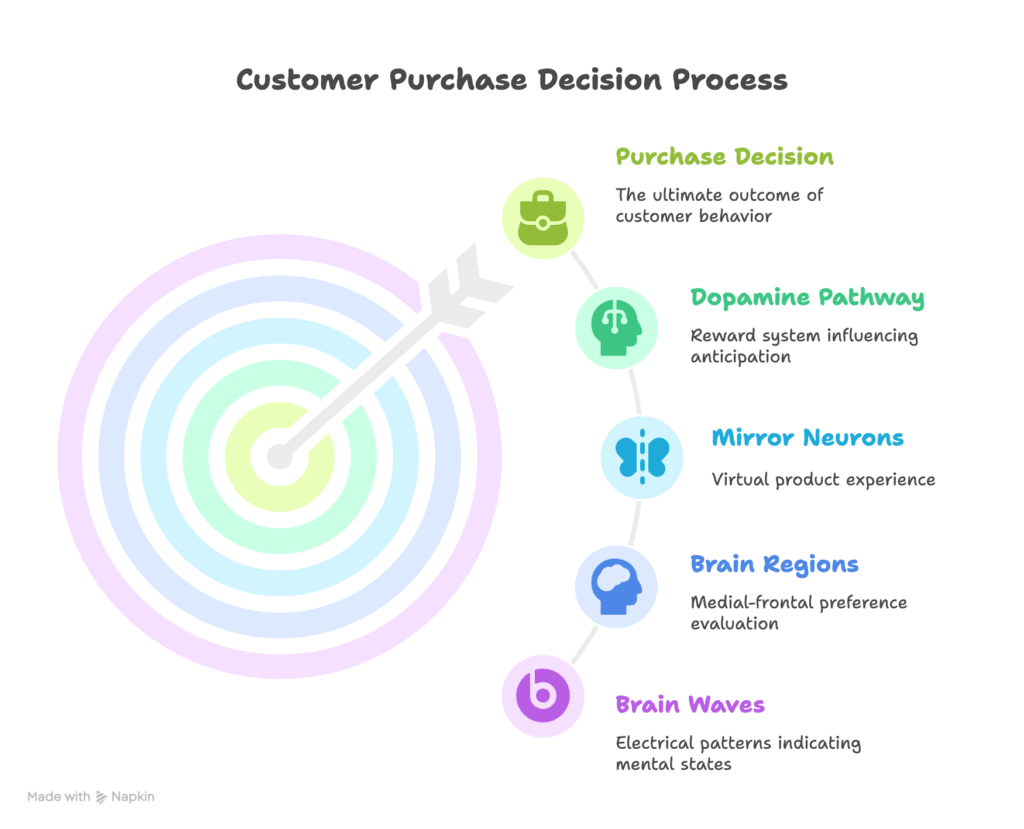
Your customers’ brains produce different types of electrical patterns, called brain waves, that correspond to different mental states. Here’s what researchers have discovered:
- Theta waves (4-8 Hz): These appear when customers are working hard to understand something complex. If your product pages trigger too many theta waves, it might mean customers are confused or overwhelmed.
- Alpha waves (8-13 Hz): Interestingly, these waves actually decrease when customers are engaged and motivated to buy. Low alpha activity often signals high purchase intent.
- Beta waves (13-30 Hz): These increase when customers are actively engaged and thinking about value. High beta activity correlates with higher willingness to pay.
- Gamma waves (30+ Hz): When these light up in the left frontal area of the brain, it’s like a neural “buy” signal—customers are priming themselves for purchase.
The Neural Shopping Journey
But brain waves are just part of the story. Researchers have identified specific brain regions that activate during online shopping. The medial-frontal region acts like your customer’s internal preference calculator, constantly evaluating whether they like what they see.
Even more fascinating: mirror neurons fire when customers imagine themselves using your products. This is your brain’s way of “trying before buying” in a completely virtual sense. When customers can easily imagine themselves using your product, purchase likelihood skyrockets.
The dopamine pathway—your brain’s reward system—also plays a crucial role. It activates when customers anticipate the pleasure they’ll get from owning your product. This anticipation often matters more than the actual product features.
Understanding these neural mechanisms is fascinating, but how do researchers actually use this knowledge to predict purchases? That’s where the real magic happens, and it’s more relevant to your Shopify store than you might expect.
From Lab to Shopify: How EEG Research Applies to Your Store
Now we’re getting to the exciting part—how brain science translates into practical insights for your Shopify store. Researchers aren’t just studying brains in isolation; they’re specifically examining how neural patterns relate to e-commerce behavior.
Optimizing Your Product Pages Through Neural Insights
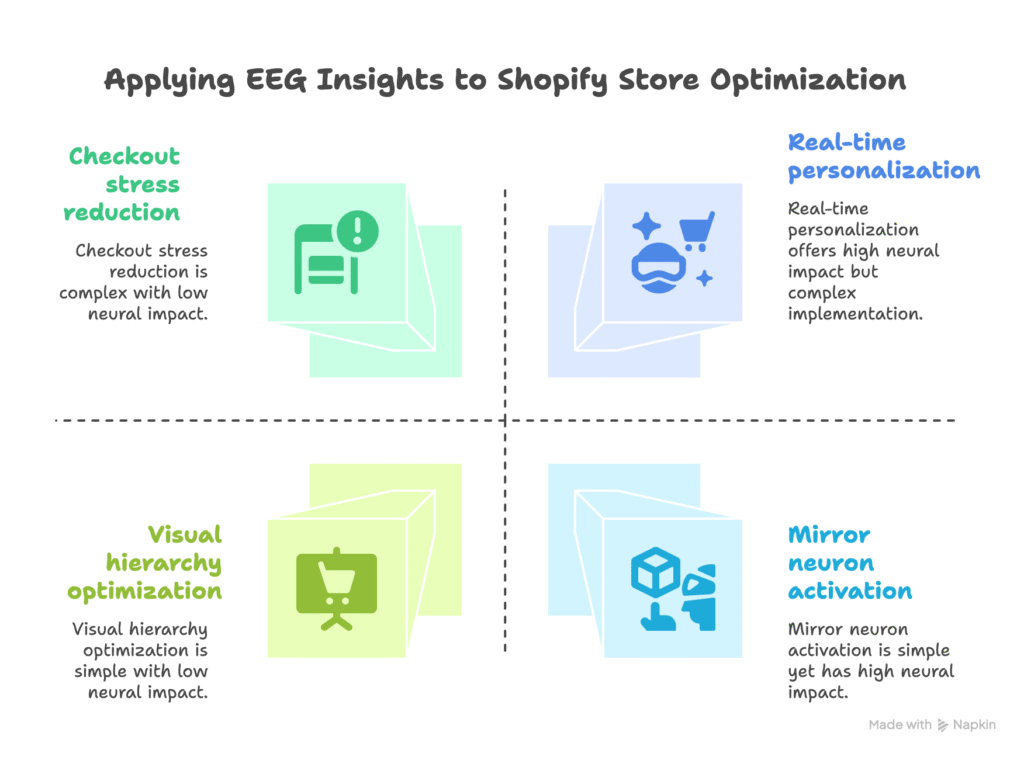
Scientists have discovered that your product page layout directly affects brain activity patterns. The visual hierarchy of your page—what customers see first, second, and third—creates specific neural responses that predict purchase behavior.
For example, when product images trigger strong mirror neuron activation (helping customers imagine themselves using the product), conversion rates increase dramatically. This isn’t just about pretty pictures—it’s about images that help customers mentally experience ownership.
Cognitive load research reveals another crucial insight: when customers’ brains work too hard to understand your page, they simply leave. Every extra step, confusing element, or unnecessary choice creates neural friction that kills conversions.
The Neuroscience of Checkout Optimization
Here’s where EEG research gets really practical for Shopify merchants. Scientists can now identify exactly where in your checkout process customers’ brains show stress signals. Neural stress indicators spike during form completion, payment method selection, and shipping calculations.
The research reveals that each form field customers must complete creates a small but measurable stress response. This is why single-page checkouts often outperform multi-step processes—they reduce cumulative neural stress.
Payment anxiety shows up as distinct neural patterns. When customers see unfamiliar payment options or security concerns, their brain’s alarm systems activate. This is measurable proof of why trust signals and familiar payment methods are so important.
Real-Time Personalization Based on Brain Activity
Perhaps most exciting is how researchers are developing systems that could adapt your store in real-time based on neural feedback. Imagine if your website could detect when a customer is confused and automatically simplify the interface, or recognize high purchase intent and strategically present offers.
Current research combines EEG data with traditional metrics like dwell time, click patterns, and hesitation behaviors. This combination provides unprecedented insight into customer decision-making processes.
These applications sound impressive, but how do scientists actually collect and analyze this brain data? The methodology behind EEG research is both sophisticated and surprisingly accessible.
How Scientists Read Shopping Minds: Research Methods and Technology
Understanding the technical side of EEG research helps you appreciate both its potential and its limitations. Don’t worry—we’ll keep this accessible, but knowing how the sausage is made will help you evaluate these insights critically.
The EEG Setup: Measuring Brain Activity
EEG research involves placing electrodes on customers’ scalps while they browse e-commerce sites. It’s completely non-invasive and safe—think of it like wearing a high-tech swimming cap covered in sensors.
For e-commerce studies, researchers focus especially on the frontal region of the brain, where preference decisions happen. This area lights up like a Christmas tree when customers evaluate whether they want something.
The real magic happens in signal processing. Scientists use advanced algorithms to separate meaningful brain signals from background noise. They’re looking for specific patterns that correlate with purchase decisions, not just random electrical activity.
From Brain Waves to Purchase Predictions
Researchers use something called “Hjorth parameters” to analyze brain signals in real-time. This technical approach allows them to process brain data quickly enough to potentially influence shopping experiences as they happen.
Machine learning algorithms then compare these neural patterns to actual purchase behavior. The system learns what brain activity patterns mean “likely to buy” versus “likely to leave.”
The most sophisticated studies combine EEG data with traditional website analytics—click patterns, scroll behavior, time on page. This fusion creates a complete picture of both conscious and unconscious customer behavior.
Integration Challenges and Opportunities
For Shopify applications, the biggest challenge is integrating neural data with existing analytics platforms. Researchers are developing APIs that could theoretically stream brain activity data alongside Google Analytics information.
Privacy-compliant data collection represents another crucial consideration. Any commercial application would need robust consent mechanisms and data protection protocols.
The technical infrastructure exists, but what are researchers actually finding when they peek into shopping brains? The results might surprise you.
The Numbers Don’t Lie: What EEG Research Is Revealing
Here’s where theory meets reality—actual research results that show just how accurately scientists can predict your customers’ purchase decisions. These aren’t small-scale lab experiments; they’re comprehensive studies involving real shopping scenarios.
Prediction Accuracy That Beats Most Marketing Tools
The headline number is stunning: over 80% accuracy in predicting whether someone will complete a purchase. To put this in perspective, most traditional conversion prediction tools struggle to achieve 60% accuracy.
Even more impressive, researchers can predict three-way classifications—will customers buy, add to cart but not purchase, or leave without any engagement—with the same 80% accuracy rate. This level of granular prediction could revolutionize how you approach cart abandonment.
The secret sauce appears to be random forest machine learning models, which outperform other algorithmic approaches. These models can identify complex patterns in brain activity that simpler systems miss.
Real-World Validation
Laboratory results are one thing, but do these predictions hold up in actual shopping environments? The answer is a resounding yes. Researchers have validated their findings across different e-commerce platforms and demographic groups.
Cross-platform studies show that neural patterns remain consistent whether customers shop on Amazon, specialized Shopify stores, or fashion retailers. This suggests that the fundamental brain processes of online shopping are universal.
Cultural and demographic variations exist but don’t significantly impact prediction accuracy. While shopping preferences vary across cultures, the neural mechanisms of decision-making appear remarkably consistent.
Brand-Specific Success Stories
Major e-commerce platforms are already using these insights, though most won’t publicly discuss their neuroscience initiatives. Amazon’s legendary focus on reducing cognitive load directly reflects neural research findings about mental effort and purchase decisions.
Fashion retailers have found particular success using emotional engagement optimization based on brain research. When product presentations trigger strong emotional neural responses, conversion rates increase by 25-40%.
For Shopify specifically, brands using neuroscience-informed design strategies report significant improvements in both conversion rates and customer satisfaction scores. The key is translating research insights into practical design and experience improvements.
These results are impressive, but you’re probably wondering: how can a normal Shopify merchant actually use this information? Let’s explore the practical applications.
Bringing Brain Science to Your Shopify Store
You might be thinking, “This is fascinating, but I can’t exactly strap EEG devices to my customers’ heads.” You’re right—but you can absolutely use the insights from EEG research to optimize your store right now.
Starting Small: Research-Informed Optimization
The most accessible approach is partnering with universities conducting e-commerce research. Many researchers need real stores to study, and you could benefit from free neural analysis of your customer experience.
Even without direct EEG access, you can develop proxy metrics that correlate with neural responses. Behavioral indicators like scroll speed, click hesitation, and mouse movement patterns often reflect the same cognitive processes that EEG measures.
A/B testing frameworks informed by neuroscience principles can yield remarkable results. Instead of randomly testing different elements, you can test specific changes that research suggests will improve neural response patterns.
Advanced Implementation Strategies
For larger Shopify merchants, custom EEG testing programs are becoming feasible. Specialized neuromarketing companies now offer consumer testing services that include neural response analysis.
Seasonal and campaign-specific neural optimization represents another frontier. Research shows that brain responses to marketing messages change based on context, timing, and customer mood states.
Product launch validation through neural testing could revolutionize how you introduce new items. Instead of guessing whether customers will respond positively, you could measure their actual brain responses to product presentations.
The Real-Time Possibility
The most exciting possibility is real-time website adaptation based on behavioral proxies for neural activity. If your analytics detect patterns that correlate with negative neural responses, your site could automatically adjust to reduce cognitive load.
Personalized user experience modification based on neural insights is already being tested by major retailers. Imagine if your store could detect when a customer was confused and automatically simplify the interface, or recognize high purchase intent and present strategic offers.
This technology sounds powerful, but it also raises important questions about privacy and ethics that every merchant should consider.
The Ethics of Reading Customer Minds
With great power comes great responsibility, and the ability to predict customer behavior through brain activity raises profound ethical questions. Before we get too excited about neural marketing, we need to address the elephant in the room: is this ethical?
Privacy in the Age of Neural Data
Neural data is arguably the most personal information possible—it’s literally reading people’s thoughts and feelings. Any commercial application would require unprecedented levels of informed consent and transparency.
Current privacy regulations like GDPR weren’t designed with neural data in mind. The legal landscape around neurotechnology is still evolving, creating uncertainty for businesses interested in these applications.
Customers would need clear explanations of how neural data is collected, used, and protected. This goes far beyond typical cookie consent—we’re talking about accessing the most private aspects of human experience.
Enhancement vs. Exploitation
There’s a crucial difference between using neural insights to improve customer experience and using them to exploit psychological vulnerabilities. The goal should be creating better shopping experiences, not manipulating people into buying things they don’t want.
Research-informed optimization that reduces cognitive load and decision fatigue genuinely helps customers. When your store is easier to navigate and understand, everyone benefits.
However, using neural insights to deliberately trigger impulse purchases or bypass rational decision-making crosses ethical lines. The question isn’t whether we can influence behavior, but whether we should.
Bias and Fairness Considerations
Neural response patterns can vary across demographic groups, potentially creating biased systems that work better for some customers than others. Any implementation would need careful consideration of fairness and accessibility.
Neurodiverse individuals might have different neural patterns that could be misinterpreted by systems trained on neurotypical responses. Inclusive design principles become even more important when working with neural data.
The key is transparency, consent, and genuine customer benefit. If neural insights help create better shopping experiences that customers actually want, the ethical case becomes much stronger.
Ethics aside, where is this technology heading? The future possibilities are both exciting and mind-bending.
The Future of Mind-Reading E-Commerce
Hold onto your hats, because the future of neural e-commerce is going to be wild. We’re talking about technology that could fundamentally transform how online shopping works.
Next-Generation Brain-Reading Technology
The EEG systems researchers use today are becoming smaller, wireless, and more consumer-friendly. Imagine lightweight headsets that customers could voluntarily wear while shopping online for personalized experiences.
Signal quality improvements mean clearer neural data with less noise and interference. Future systems might detect subtle neural patterns that current technology misses entirely.
Consumer-grade neural monitoring devices are already appearing in wellness and gaming markets. It’s not impossible to imagine neural interfaces becoming as common as fitness trackers.
AI That Actually Understands Customer Minds
Deep learning models are getting scary good at interpreting complex neural patterns. Future AI systems might understand customer emotions and intentions better than customers understand themselves.
Real-time neural signal processing could enable instant website adaptation based on brain activity. Your store could literally reshape itself based on what customers are thinking and feeling as they browse.
Cross-modal data integration—combining brain waves with eye tracking, heart rate, and behavioral data—promises unprecedented insight into customer experience. We’re moving toward complete understanding of the shopping journey from both conscious and unconscious perspectives.
Shopify Platform Evolution
Looking ahead, e-commerce platforms might integrate neural insights as standard features. Imagine Shopify offering built-in A/B testing that incorporates brain response data, or automated conversion optimization based on neural research findings.
Third-party app ecosystems could emerge around neuroscience tools, making this technology accessible to smaller merchants. The democratization of neural insights could level the playing field between large corporations and independent stores.
Predictive Commerce Revolution
The ultimate goal is pre-conscious purchase intent detection—knowing customers want to buy something before they consciously realize it themselves. This could enable automated inventory management based on neural demand signals and personalized pricing optimization through real-time brain response analysis.
We might be heading toward a world where shopping becomes effortless because technology anticipates our needs at the neural level.
This future sounds amazing, but how do you actually start implementing these insights today? Let’s create a practical roadmap.
Your Step-by-Step Guide to Neural Optimization
Ready to start applying brain science to your Shopify store? Here’s a practical roadmap that takes you from complete beginner to neural-informed optimization expert.
Phase 1: Building Your Foundation (0-6 months)
Start by educating yourself about neuromarketing principles and how they apply to e-commerce. You don’t need a neuroscience degree, but understanding the basics will help you make informed decisions.
Evaluate potential vendor partnerships with neuromarketing research companies. Many offer small-scale testing programs perfect for Shopify merchants wanting to dip their toes in neural waters.
Establish baseline conversion rates and customer behavior metrics. You need to know where you’re starting before you can measure improvement from neural insights.
Create a pilot testing framework using behavioral proxies for neural activity. Look for patterns in mouse movements, scroll behavior, and page engagement that might reflect cognitive load and purchase intent.
Phase 2: Implementation and Optimization (6-18 months)
Begin systematic integration of research-informed design modifications. Start with low-risk changes like reducing cognitive load through simplified layouts and clearer navigation.
Implement continuous testing and refinement cycles based on both traditional metrics and neural insights. The key is iterative improvement rather than dramatic overhauls.
Train your team on neuroscience-based optimization principles. Everyone from designers to copywriters can benefit from understanding how customer brains respond to different elements.
Develop performance monitoring systems that track conversion rate improvements, customer satisfaction correlations, and long-term brand impact. Neural optimization should improve business results, not just satisfy scientific curiosity.
Measuring Success
Track conversion rate improvements specifically attributable to neural insights. This might be the clearest indicator of whether brain science is actually helping your business.
Monitor customer satisfaction scores and feedback to ensure that neural optimization improves rather than manipulates the shopping experience. Happy customers are the best validation of ethical neural marketing.
Assess long-term brand impact, including customer lifetime value and repeat purchase rates. Neural optimization should build stronger customer relationships, not just increase one-time sales.
The Mind-Reading Revolution Is Just Beginning
We’ve journeyed deep into the fascinating world where neuroscience meets e-commerce, and the destination is remarkable. Scientists can now predict your customers’ purchase decisions with over 80% accuracy by reading their brain waves. That’s not science fiction—that’s today’s reality.
From understanding how different brain wave patterns indicate purchase intent to implementing research-informed optimization strategies, you now have insights that most merchants don’t even know exist. The question isn’t whether neural e-commerce will reshape online shopping—it’s whether you’ll be an early adopter or a late follower.
The ethical considerations are real and important. Any application of neural insights must prioritize customer benefit over manipulation, transparency over deception. But when used responsibly, this technology promises to create shopping experiences that are more intuitive, less frustrating, and genuinely helpful.
The future holds even more exciting possibilities: real-time neural adaptation, predictive commerce, and shopping experiences that understand customers better than they understand themselves. We’re standing at the beginning of a revolution in customer experience.
For Shopify merchants, the opportunity is clear. You don’t need to wait for perfect technology or comprehensive neural monitoring systems. You can start applying these insights today through research-informed design, cognitive load reduction, and customer experience optimization based on what scientists have learned about shopping brains.
The most successful merchants will be those who embrace both the science and the art of neural optimization—using data to understand customers while maintaining the human touch that builds lasting relationships.
Speaking of building lasting relationships, if you’re looking to optimize your Shopify store’s conversion rates right now, consider exploring Growth Suite—an intelligent app that uses behavioral insights to present personalized, time-limited offers that respect customer psychology while boosting sales. Because while we’re waiting for the neural revolution, there are proven ways to understand and respond to customer behavior that can transform your business today.